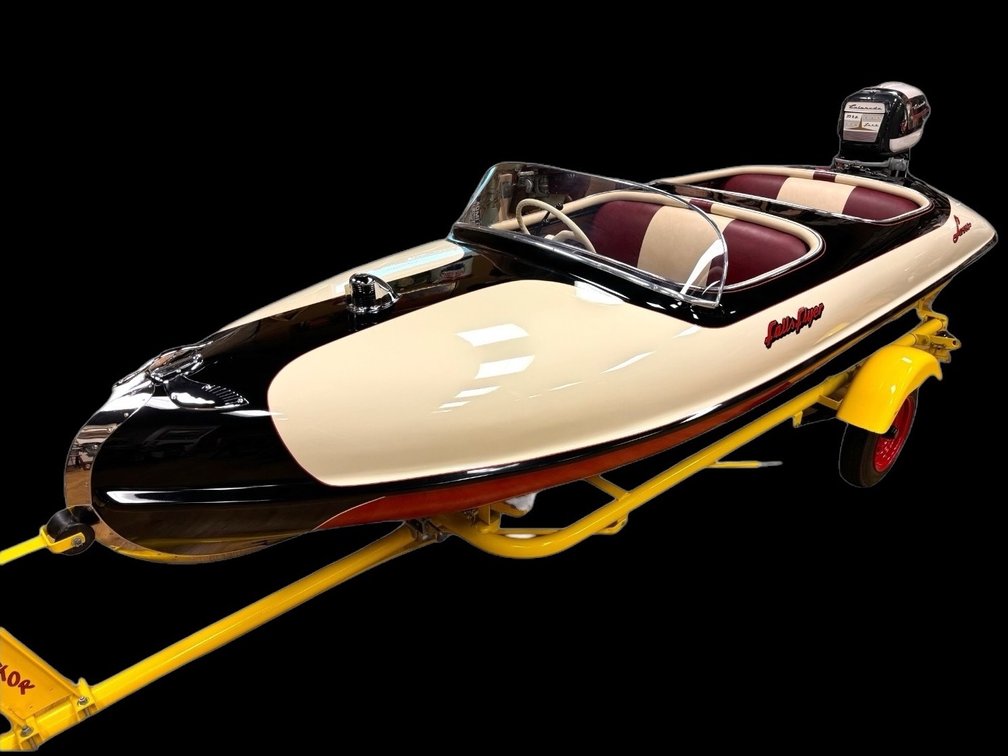
#2 • 1956 Larson 14’ Falls Flyer + 35HP Evinrude Lark + National Gator Trailer
Part of Classic Outboard Auction (timed auction by Estate Online Auctions)
Status: Sold
Category: Boats
1956 Larson 14’ Falls Flyer + 35HP Evinrude Lark + National Gator Trailer Beautifully restored, ready for the boat show! Incredible condition with only a few small chips in the paint. Windshield has a crack but a replacement windshield is included. 14’ Fiberglass Hull 1957 Evinrude 35hp in great running condition. Electric choke does not work, need to choke manually. 1963 Gator Trailer by National 1-7/8” hitch. In 1939, Larson Boat Works launched the Falls Flyer, available in 12- and 14-foot lengths and designed for the most powerful outboard motors of the time. Paul Larson secured a design patent for an inboard version in 1940, which was granted on April 15, 1941. The Falls Flyer was a hit at the 1941 Chicago Boat Show, generating more orders than Larson could fulfill. Unfortunately, World War II soon began, hindering the boat's potential success. The history of this distinctive Minnesota-made boat is as captivating as its looks and all thanks to the Falls Flyer pioneering creator, Paul Larson of Larson Boat Works. Larson was one of the admiring millions who watched Charles Lindbergh's historic landing at the Le Bourget Air Field in Paris in 1927. Larson, like many, was impressed by Lindbergh's remarkable transit of the Atlantic Ocean and he wanted to honor the famous aviator in a new line of boats. From this admiration the Falls Flyer was invented and named to honor Lindbergh. The word "Flyer" was out of respect for the aviator's outstanding 3,600-mile solo flight and "Falls" for Little Falls, the central Minnesota hometown of both Larson and Lindbergh. Larson was a prodigy who built his first boat from scraps at the age of 11. He was a successful entrepreneur while still a teenager. His boat factory, located on the Mississippi River, was well established by 1927, and it was manufacturing hundreds of handcrafted wooden boats. Production of the Falls Flyer began in 1937 with the design of the boat as a rounded-hull vessel with a double cockpit built of canvas on wood. It resembled and had many features of Lindbergh's Curtiss biplane, model JN4, which was named Jenny. This was the plane that Lindbergh flew while barnstorming and carrying mail in the years prior to the famous Spirit of St. Louis he flew across the Atlantic. The first outboard Falls Flyers were built in 1938 and were constructed using techniques similar to early canoe building. Thin cedar strips were screwed to oak ribs and then aircraft canvas was tightly stretched over this framework and glued. The boats were given a distinctive tri-color paint job. The bottom to the splash guards were adorned with bright red marine enamel with the bow and part of the deck painted black. The remainder of the boat was decorated with an ivory paint. All of the colors were blended at the bow of the boat. Larson patented the idea for this boat that would capture the American heart. Pride in the innovative creation along with numerous modernizations prompted the successful inventor to take out a patent in 1941 for "a new original and ornamental Design for Boats." The boat was sleek and stylish with a narrow, low-slung bullet shape. Larson abbreviated the transom, surrounding it with a sloping rear deck that went right to the waterline, which to this day is an industry standard for high-performance recreational outboards. The wooden boat had an airplane-like body and cockpit. Although the 25 inboard Flyers that were manufactured drew mixed reviews for their tendency to torpedo or sink in big waves, the outboards attracted quite a number of fans. A few 21-foot inboards were built, along with one 17-foot model, and a handful of the single-seat speedster models. World War II brought an end to recreational boat building at the Larson Boat factory. Then, in December of 1949, the factory was engulfed in flames that consumed everything, including boats, patterns, molds and records. It was shortly after the tragedy that Larson began implementing the new fiberglass technology that was promising smoother marine rides. This new innovation brought about watercrafts that were stronger and nearly maintenance-free. The first molded fiberglass Flyer model was revealed in 1954. By shaping the internal structure of the original design these extraordinary Flyers were much lighter than that of the competition though only built until 1957. By 1958, however, Larson had presented other novelties to the Flyer line: fins and probably the first all-black molded boats. The dorsal wings on either side of the motor transom, briefly popular on automobiles, never seemed to take off, and the Flyer line ended after 1960. Only about 99 Flyers are still around today. Over half of those boats are the fiberglass model, according to Ross Pfund, editor of Flyer Fever. He also reported that some 31 wooden Flyers remain, including 19 outboards and 12 inboards.